Arc B770
Executive Summary
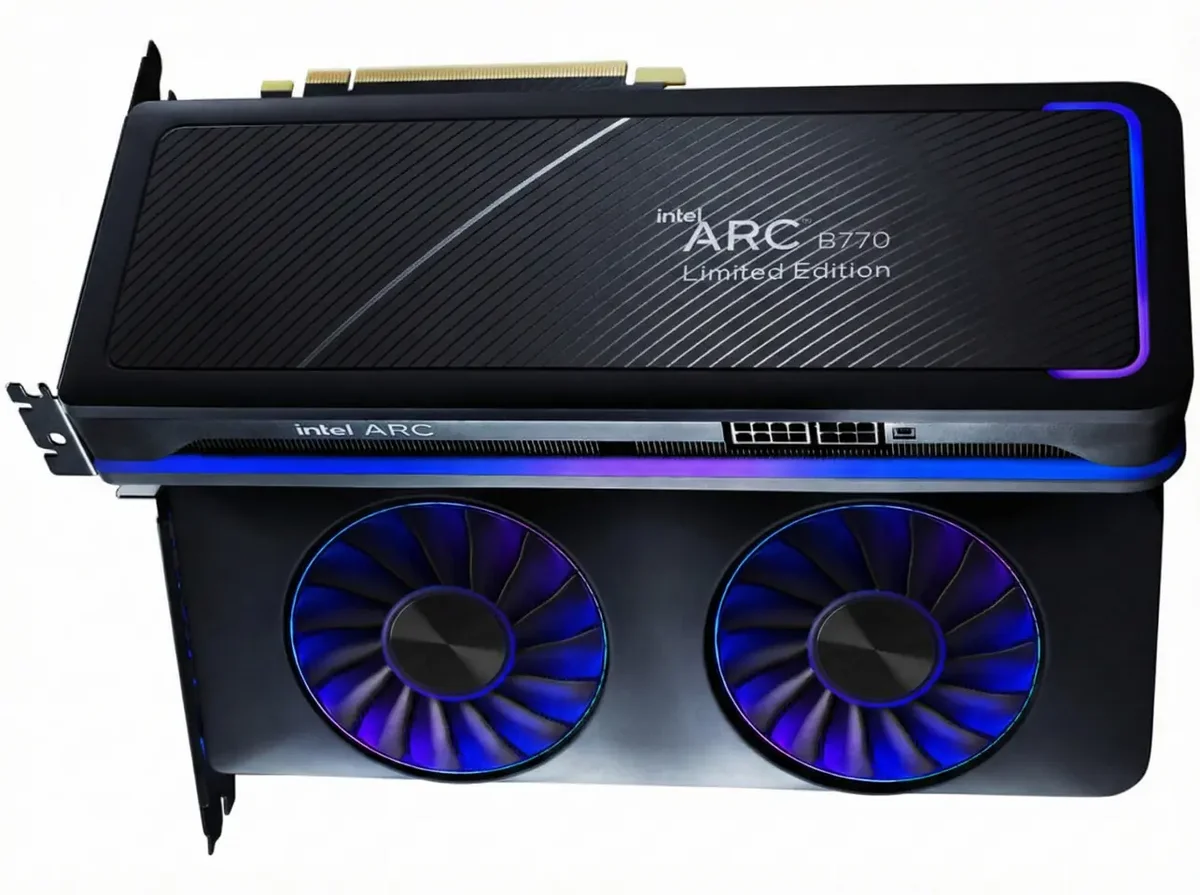
The Intel Arc B770 is a discrete graphics processing unit (GPU) developed by Intel, representing the company's line of discrete GPUs for gaming and content creation. This product matters as it signifies Intel's continued efforts to challenge the dominance of NVIDIA and AMD in the graphics market. With its Battlemage GPU, the Arc B770 is set to offer competitive performance, high memory capacity, and potentially attractive pricing. The Arc B770 is part of Intel's Arc series, which aims to provide high-performance graphics solutions for gamers and content creators. Given its specifications and features, the B770 is likely to appeal to those seeking a balance between performance and power consumption. As the graphics market continues to evolve, the Arc B770's release is anticipated with interest, especially considering its potential to disrupt the status quo. The significance of the Arc B770 extends beyond its technical specifications. It represents Intel's commitment to the graphics market and its ambition to become a major player. The success of the Arc B770 could have implications for the entire industry, potentially leading to increased competition and innovation. As such, the Arc B770 is not just a product but a milestone in Intel's journey to establish itself as a significant force in the world of graphics processing.Architecture & Design
The Intel Arc B770 is powered by the Battlemage GPU, specifically the BGM-G31 model. This GPU features 5120 CUDA cores, 320 TMUs (Texture Mapping Units), and 160 ROPs (Raster Operations Pipelines). The architecture of the B770 is based on the TSMC N5 process node, which is a generational leap from the N6 node used in the Arc Alchemist series. This process node enables higher clock speeds at lower power consumption, making the B770 potentially more efficient than its predecessors. The B770 comes with 16GB of GDDR6 memory, which is a significant amount for a GPU in its class. The memory is connected via a 256-bit bus, providing a substantial memory bandwidth. The GPU also features 32 Xe2 cores, which are part of Intel's Xe architecture designed for high-performance graphics processing. The L2 cache size is 16 MB, which helps in reducing memory latency and improving overall system performance. The design of the Arc B770 reflects Intel's focus on balancing performance and power consumption. With a TDP (Thermal Design Power) of 225W, the B770 is positioned as a high-performance GPU that can handle demanding games and applications without excessive power draw. The use of the TSMC N5 process node and the Xe2 cores are key factors in achieving this balance, allowing the B770 to offer competitive performance while maintaining a relatively low TDP.Performance & Thermal
The performance of the Intel Arc B770 is expected to be competitive with other high-end GPUs in the market. Although specific benchmark scores are not publicly disclosed, the combination of 5120 CUDA cores, 320 TMUs, and 160 ROPs suggests that the B770 can handle demanding graphics workloads. The 16GB of GDDR6 memory and the 256-bit bus provide ample memory bandwidth, which is crucial for high-resolution gaming and content creation. The thermal design power (TDP) of the Arc B770 is 225W, which is relatively low compared to some other high-end GPUs. This suggests that the B770 is designed to operate efficiently, minimizing heat generation and power consumption. However, the actual thermal performance of the B770 will depend on various factors, including the system configuration, cooling solution, and workload. As such, it is essential to consider the TDP in the context of the entire system, rather than in isolation.Market Positioning
The Intel Arc B770 is positioned as a high-performance GPU for gaming and content creation. With its competitive specifications and potentially attractive pricing, the B770 is likely to appeal to a wide range of users. The 16GB of GDDR6 memory, in particular, makes the B770 an attractive option for those who require high memory capacity for their applications. The market positioning of the Arc B770 is also influenced by its release date, which is scheduled for Q4 2025. This timing suggests that Intel is aiming to capitalize on the holiday season and the subsequent demand for high-performance graphics solutions. By releasing the B770 during this period, Intel can potentially gain a competitive edge and establish the B770 as a top choice for gamers and content creators.Verdict
The Intel Arc B770 represents a significant step forward for Intel in the graphics market. With its competitive specifications, efficient design, and potentially attractive pricing, the B770 is well-positioned to challenge the dominance of NVIDIA and AMD. Although the actual performance and thermal characteristics of the B770 are not publicly disclosed, the available information suggests that it can offer a compelling balance of performance and power consumption. As the graphics market continues to evolve, the Arc B770 is likely to play a crucial role in shaping the future of high-performance graphics solutions. Its release is anticipated with interest, and its success could have significant implications for the entire industry. Whether the B770 can live up to its promise remains to be seen, but one thing is certain – the Arc B770 is a product that will be closely watched by gamers, content creators, and industry observers alike. In conclusion, the Intel Arc B770 is a product that embodies Intel's commitment to the graphics market and its ambition to become a major player. With its competitive specifications, efficient design, and potentially attractive pricing, the B770 is well-positioned to make a significant impact in the market. As the graphics industry continues to evolve, the Arc B770 is likely to be a key factor in shaping the future of high-performance graphics solutions.Specifications
| GPU | INTEL BGM-G31 |
|---|---|
| Cores | 5120 |
| TMUs | 320 |
| ROPs | 160 |
| Memory | 16GB GDDR6 |
| Bus | 256-bit |
| TDP | 225W |
| L2 Cache | 16 MB |
| Process Node | TSMC N5 |
| Release Date | Q4 2025 |
Frequently Asked Questions
What is the GPU model used in the Intel Arc B770?
The Intel Arc B770 uses the BGM-G31 GPU model.
How much memory does the Intel Arc B770 have?
The Intel Arc B770 comes with 16GB of GDDR6 memory.
What is the TDP of the Intel Arc B770?
The TDP of the Intel Arc B770 is 225W.
When is the Intel Arc B770 scheduled for release?
The Intel Arc B770 is scheduled for release in Q4 2025.