ESP32
Executive Summary
The ESP32 is a family of low-cost, energy-efficient microcontrollers that integrate both Wi-Fi and Bluetooth capabilities. These chips feature a variety of processing options and are designed for wireless data communication. The ESP32 was designed by Espressif Systems and is manufactured by TSMC using their 40 nm process. It is a successor to the ESP8266 microcontroller and offers improved performance and features.
Architecture & Design
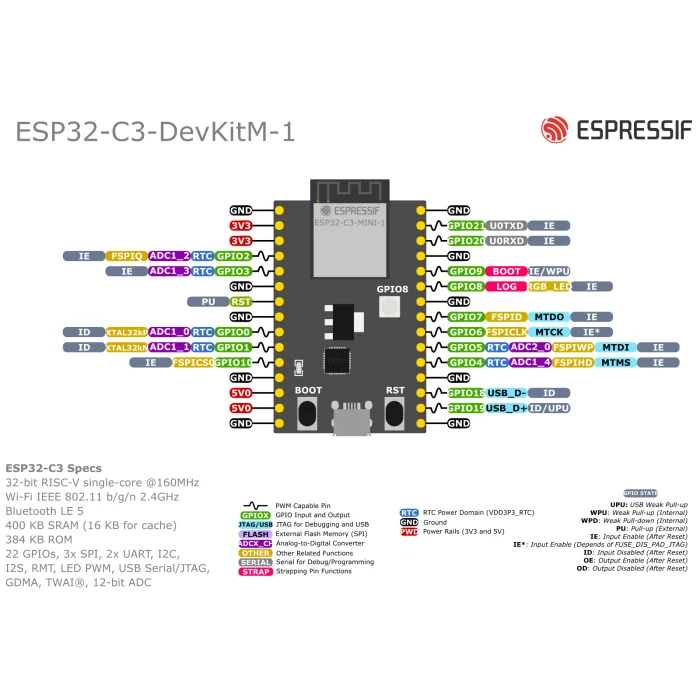
The ESP32 features a Tensilica Xtensa LX6 microprocessor, available in both dual-core and single-core variants, or a RISC-V microprocessor. The chip also includes built-in antenna switches, an RF balun, power amplifiers, low-noise receivers, filters, and power-management modules. The ESP32 is typically embedded on device-specific printed circuit boards or offered as part of development kits with varying configurations. The ESP32-C3, a specific variant, is an ultra-low-power and highly-integrated MCU-based SoC solution that supports 2.4 GHz Wi-Fi and Bluetooth 5 (LE). It is based on the open-source RISC-V architecture and offers a balance of power, I/O capabilities, and security.
The ESP32-C3 contains three digital watchdog timers: one in each of the two timer groups (called Main System Watchdog Timers, or MWDT) and one in the RTC module (called the RTC Watchdog Timer, or RWDT). It also features a 52-bit system timer with two 52-bit counters and three comparators. The chip has a variety of peripherals, including UART, SPI, I2C, I2S, and USB Serial/JTAG controllers. The ESP32-C3 also features analog signal processing capabilities, including a SAR ADC and a temperature sensor.
Performance & Thermal
The performance and thermal characteristics of the ESP32 are not fully disclosed in the provided research material. However, the ESP32-C3 datasheet provides some information on the chip's electrical characteristics, including absolute maximum ratings, recommended operating conditions, and DC characteristics. The datasheet also provides information on the chip's current consumption, including RF current consumption in active mode and current consumption in other modes.
Market Positioning
The pricing and competitive context of the ESP32 are not publicly disclosed in the provided research material. However, the ESP32 is generally considered to be a low-cost microcontroller, and its pricing is likely to be competitive with other similar products on the market.
Verdict
In conclusion, the ESP32 is a family of low-cost, energy-efficient microcontrollers that offer a range of features and capabilities. The ESP32-C3, in particular, is an ultra-low-power and highly-integrated MCU-based SoC solution that supports 2.4 GHz Wi-Fi and Bluetooth 5 (LE). While the performance and thermal characteristics of the ESP32 are not fully disclosed, the chip's electrical characteristics and current consumption are well-documented. The ESP32 is likely to be a competitive product in the market, but its pricing and positioning will depend on a variety of factors, including its target applications and the needs of its customers.
Technical Details
The ESP32-C3 is a single-core Wi-Fi and Bluetooth 5 (LE) microcontroller SoC, based on the open-source RISC-V architecture. It has a 52-bit system timer, three digital watchdog timers, and a variety of peripherals, including UART, SPI, I2C, I2S, and USB Serial/JTAG controllers. The chip also features analog signal processing capabilities, including a SAR ADC and a temperature sensor.
The ESP32-C3 is packaged in a 5 mm x 5 mm QFN package and has a variety of power modes, including active mode, modem-sleep mode, and deep-sleep mode. The chip's power management unit (PMU) is responsible for managing the chip's power consumption and can switch between different power modes to minimize power consumption.
Applications
The ESP32 is suitable for a wide range of applications, including IoT devices, wearables, and industrial control systems. The chip's low power consumption and small size make it ideal for battery-powered devices, and its Wi-Fi and Bluetooth capabilities make it suitable for applications that require wireless connectivity.
Development
The ESP32 can be developed using a variety of tools and platforms, including the ESP-IDF framework and the Arduino IDE. The chip's documentation and datasheet provide detailed information on its features and capabilities, and the ESP32 community provides a wealth of resources and support for developers.
Comparison
The ESP32 is often compared to other microcontrollers, such as the ESP8266 and the Arduino Uno. While these chips have similar features and capabilities, the ESP32 offers improved performance and features, including Wi-Fi and Bluetooth capabilities. The ESP32-C3, in particular, is an ultra-low-power and highly-integrated MCU-based SoC solution that offers a balance of power, I/O capabilities, and security.
Conclusion
In conclusion, the ESP32 is a family of low-cost, energy-efficient microcontrollers that offer a range of features and capabilities. The ESP32-C3, in particular, is an ultra-low-power and highly-integrated MCU-based SoC solution that supports 2.4 GHz Wi-Fi and Bluetooth 5 (LE). While the performance and thermal characteristics of the ESP32 are not fully disclosed, the chip's electrical characteristics and current consumption are well-documented. The ESP32 is likely to be a competitive product in the market, but its pricing and positioning will depend on a variety of factors, including its target applications and the needs of its customers.
Specifications
| Microprocessor | Tensilica Xtensa LX6 or RISC-V |
|---|---|
| Core Count | Single-core or dual-core |
| Process Node | 40 nm |
| Wi-Fi | 2.4 GHz (802.11b/g/n) |
| Bluetooth | Bluetooth 5 (LE) |
| Package | QFN32 (5x5 mm) |
| Power Modes | Active mode, modem-sleep mode, deep-sleep mode |
| Watchdog Timers | Three digital watchdog timers |
| System Timer | 52-bit system timer with two 52-bit counters and three comparators |
Frequently Asked Questions
What is the ESP32?
The ESP32 is a family of low-cost, energy-efficient microcontrollers that integrate both Wi-Fi and Bluetooth capabilities.
What is the ESP32-C3?
The ESP32-C3 is an ultra-low-power and highly-integrated MCU-based SoC solution that supports 2.4 GHz Wi-Fi and Bluetooth 5 (LE).
What are the key features of the ESP32-C3?
The ESP32-C3 features a 52-bit system timer, three digital watchdog timers, and a variety of peripherals, including UART, SPI, I2C, I2S, and USB Serial/JTAG controllers.