GeForce RTX 40 series
Executive Summary
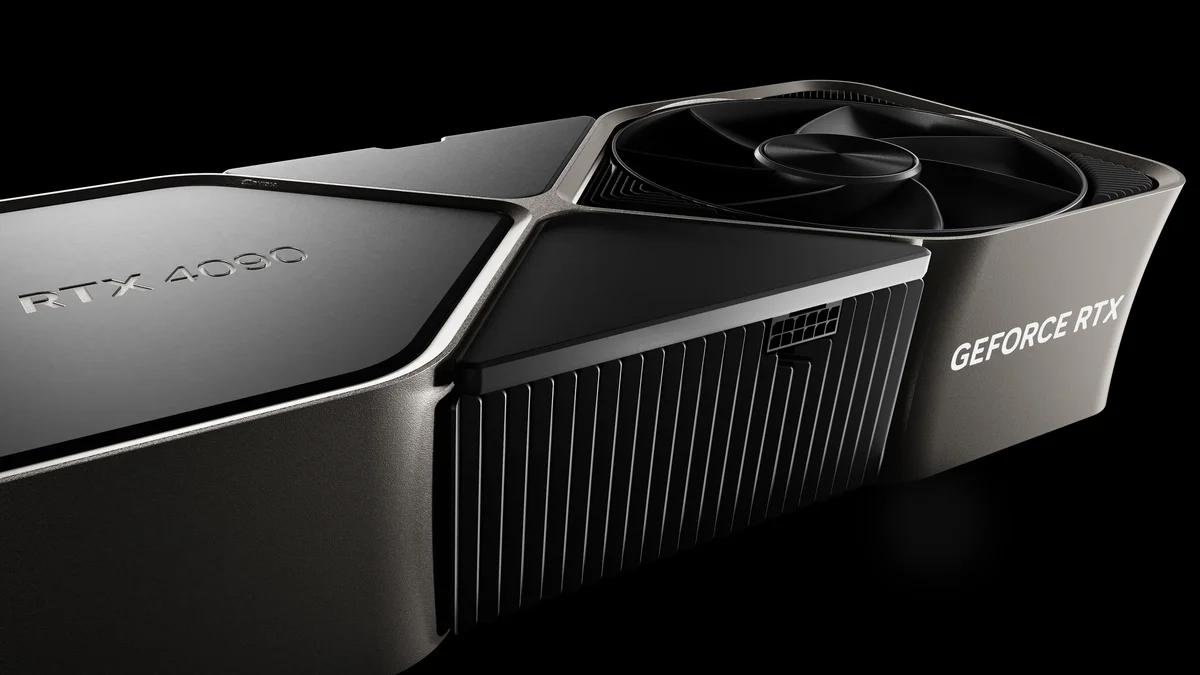
The GeForce RTX 40 series is a family of consumer graphics processing units (GPUs) in Nvidia's GeForce line of graphics cards, succeeding the GeForce RTX 30 series. The series was announced on September 20, 2022, at the GPU Technology Conference, and launched on October 12, 2022, starting with its flagship model, the RTX 4090. The RTX 40 series is based on Nvidia's Ada Lovelace architecture and features Nvidia RTX's third-generation RT cores for hardware-accelerated real-time ray tracing, and fourth-generation deep-learning-focused Tensor Cores.
Architecture & Design
The Ada Lovelace architecture is a significant improvement over the previous Ampere architecture, with several key enhancements. The architecture includes CUDA Compute Capability 8.9, TSMC 4N process (5 nm custom designed for Nvidia), and fourth-generation Tensor Cores with FP8, FP16, bfloat16, TensorFloat-32 (TF32) and sparsity acceleration. The third-generation Ray Tracing Cores, along with concurrent ray tracing, shading, and compute, provide improved performance for real-time ray tracing and other compute-intensive workloads.
The Shader Execution Reordering feature, which needs to be enabled by the developer, allows for more efficient execution of shaders, resulting in improved performance. The Dual NVENC with 8K 10-bit 120FPS AV1 fixed function hardware encoding provides high-quality video encoding, while the new generation of Optical Flow Accelerator aids DLSS 3.0 intermediate AI-based frame generation.
The RTX 40 series also features DisplayPort 1.4a and HDMI 2.1 display connections, providing support for high-resolution displays and high-refresh-rate gaming. The double-precision (FP64) performance of Ada Lovelace silicon is 1/64 of single-precision (FP32) performance, which is a significant improvement over the previous architecture.
Performance & Thermal
The RTX 40 series has received praise from reviewers for its performance, with the RTX 4090 being particularly notable for its high-end performance. The RTX 4070 Ti SUPER, which was released later in the series, has also been praised for its performance, with some reviewers noting that it is faster than the GeForce RTX 3090 Ti at nearly half the power.
The thermal performance of the RTX 40 series has also been improved, with the use of more efficient cooling systems and improved thermal management. The RTX 4070 Ti SUPER, for example, has been shown to perform well in high-frequency gaming workloads, with temperatures remaining relatively low.
Market Positioning
The RTX 40 series is positioned as a high-end lineup of graphics cards, with the RTX 4090 being the flagship model. The series is designed to provide high-performance gaming and compute capabilities, with a focus on real-time ray tracing, AI-enhanced graphics, and other advanced features.
The RTX 40 series competes with other high-end graphics cards from AMD and Intel, and its market positioning is further reinforced by its support for advanced technologies such as DLSS 3.0 and ray tracing. The series is also notable for its power efficiency, with the RTX 4070 Ti SUPER being a prime example of this, offering high performance while consuming significantly less power than its predecessors.
Technical Background
The Ada Lovelace architecture is built on a 5nm process, which provides a significant improvement in performance and power efficiency compared to the previous 8nm process used in the Ampere architecture. The use of TSMC's 4N process allows for a higher transistor density, resulting in improved performance and reduced power consumption. The architecture also features a number of other enhancements, including improved ray tracing and AI acceleration, which are made possible by the use of advanced technologies such as tensor cores and optical flow accelerators.
The technical background of the RTX 40 series is also notable for its use of advanced materials and manufacturing techniques. The use of high-quality materials and precise manufacturing processes allows for the creation of high-performance graphics cards that are both reliable and efficient. The RTX 40 series is also designed to be highly scalable, with support for multiple graphics cards and advanced cooling systems.
Competitive Landscape
The RTX 40 series competes with other high-end graphics cards from AMD and Intel, including the Radeon RX 7000 series and the Arc A-series. The Radeon RX 7000 series is based on AMD's RDNA 3 architecture and features support for advanced technologies such as ray tracing and variable rate shading. The Arc A-series, on the other hand, is based on Intel's Xe-HPG architecture and features support for advanced technologies such as ray tracing and AI acceleration.
The competitive landscape of the RTX 40 series is also notable for its focus on power efficiency and performance. The RTX 4070 Ti SUPER, for example, offers high performance while consuming significantly less power than its predecessors, making it an attractive option for gamers and content creators who require high-performance graphics cards that are also power efficient. The RTX 40 series is also notable for its support for advanced technologies such as DLSS 3.0 and ray tracing, which provide a significant improvement in performance and image quality compared to previous generations of graphics cards.
Specifications
| CUDA Compute Capability | 8.9 |
|---|---|
| Process | TSMC 4N (5 nm) |
| Tensor Cores | Fourth-generation |
| Ray Tracing Cores | Third-generation |
| Display Connections | DisplayPort 1.4a, HDMI 2.1 |
Frequently Asked Questions
What is the architecture of the RTX 40 series?
The RTX 40 series is based on Nvidia's Ada Lovelace architecture.
What is the process used in the RTX 40 series?
The RTX 40 series is built on a 5nm process.
What is the performance of the RTX 40 series?
The RTX 40 series has received praise from reviewers for its high-end performance.