Intel Arc
Executive Summary
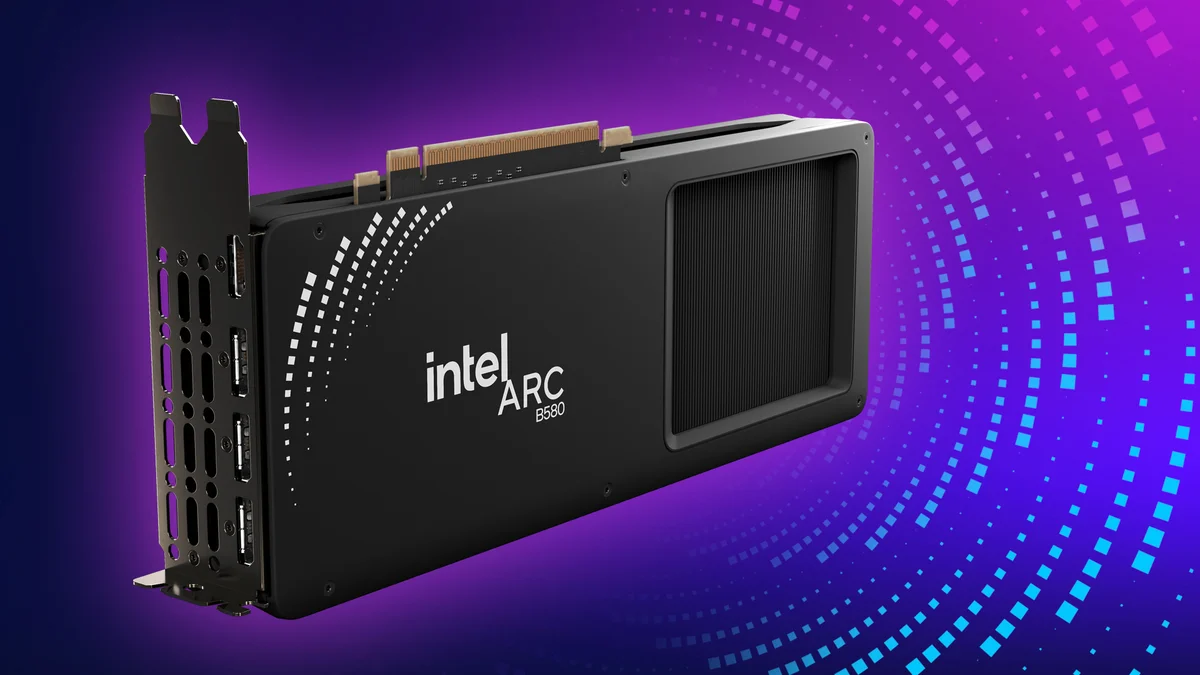
Intel Arc is a brand of graphics processing units (GPUs) developed by Intel, representing the company's line of discrete GPUs for gaming, content creation, and professional applications. Arc GPUs are designed by Intel and manufactured under contract by TSMC. The brand also includes supporting graphics software and driver technologies, and is sold alongside Intel Graphics Technology, the company's line of integrated graphics processors, found in most of its processors.
Intel Arc competes with Nvidia's GeForce and AMD's Radeon products. The first generation, the Arc A-series, launched in 2022 with laptop GPUs debuting in March and desktop models such as the A750 and A770 following later that year. The Arc Pro series for workstation use was introduced in August 2022, followed by the second-generation Battlemage (B-series) GPUs, announced in December 2024.
Architecture & Design
The Intel Arc architecture is based on the Xe GPU architecture, or more specifically, the Xe-HPG variant. This architecture supports hardware-based ray tracing, XeSS or supersampling based on neural networks (similar to Nvidia's DLSS and AMD's FSR), and DirectX 12 Ultimate. Also supported are DisplayPort 2.0 and overclocking. AV1 fixed-function hardware encoder is included in Alchemist GPUs as part of the Intel Quick Sync Video core.
Alchemist uses the Intel Xe GPU architecture, which is designed to provide high performance and power efficiency. The Xe-HPG variant is specifically designed for high-performance gaming and content creation applications. The architecture includes a number of features such as hardware-based ray tracing, XeSS, and DirectX 12 Ultimate, which provide improved performance and functionality for gaming and content creation applications.
The Arc Alchemist does not support SR-IOV or Direct3D 9 natively, instead falling back on the D3D9On12 wrapper which translates Direct3D 9 calls to their Direct3D 12 equivalents. Arc support OpenCL 3.0, for example, this GPU can work in the grid World Community Grid. Display connections include DisplayPort 2.0 (40 Gbit/s bandwidth) and HDMI 2.1.
Performance & Thermal
The performance of the Intel Arc GPUs is competitive with other high-end GPUs on the market. The Arc A750 and A770, for example, offer performance similar to the Nvidia GeForce RTX 3060 and AMD Radeon RX 6600 XT, respectively. The Arc Pro series, on the other hand, is designed for workstation use and offers high performance and features such as ECC memory and multi-GPU support.
The thermal performance of the Intel Arc GPUs is also competitive with other high-end GPUs. The Arc A750 and A770, for example, have a thermal design power (TDP) of 225W and 250W, respectively, which is similar to the TDP of other high-end GPUs on the market. The Arc Pro series, on the other hand, has a higher TDP due to its higher performance and features.
Market Positioning
Intel Arc is positioned as a high-end GPU brand, competing with Nvidia's GeForce and AMD's Radeon products. The brand is designed to provide high performance and features for gaming, content creation, and professional applications. The Arc A-series, for example, is designed for gaming and content creation, while the Arc Pro series is designed for workstation use.
The market positioning of Intel Arc is also reflected in its pricing. The Arc A750 and A770, for example, are priced competitively with other high-end GPUs on the market, such as the Nvidia GeForce RTX 3060 and AMD Radeon RX 6600 XT. The Arc Pro series, on the other hand, is priced higher due to its higher performance and features.
Verdict
In conclusion, Intel Arc is a high-end GPU brand that offers competitive performance and features for gaming, content creation, and professional applications. The brand is positioned to compete with Nvidia's GeForce and AMD's Radeon products, and its pricing reflects its high-end market positioning.
The Intel Arc architecture is based on the Xe GPU architecture, which provides high performance and power efficiency. The Xe-HPG variant is specifically designed for high-performance gaming and content creation applications, and includes features such as hardware-based ray tracing, XeSS, and DirectX 12 Ultimate.
Overall, Intel Arc is a strong competitor in the high-end GPU market, and its performance and features make it a good option for gamers, content creators, and professionals who require high-end graphics performance.
Specifications
| GPU Architecture | Xe-HPG |
|---|---|
| Manufacturing Process | TSMC N6 |
| Ray Tracing | Hardware-based |
| XeSS | Supersampling based on neural networks |
| DirectX Support | DirectX 12 Ultimate |
| DisplayPort | DisplayPort 2.0 (40 Gbit/s bandwidth) |
| HDMI | HDMI 2.1 |
| AV1 Encoder | Fixed-function hardware encoder |
| OpenCL Support | OpenCL 3.0 |
| TDP | 225W (A750), 250W (A770) |
Frequently Asked Questions
What is Intel Arc?
Intel Arc is a brand of graphics processing units (GPUs) developed by Intel, representing the company's line of discrete GPUs for gaming, content creation, and professional applications.
What is the Intel Arc architecture?
The Intel Arc architecture is based on the Xe GPU architecture, or more specifically, the Xe-HPG variant, which provides high performance and power efficiency.
What features does the Intel Arc architecture include?
The Intel Arc architecture includes features such as hardware-based ray tracing, XeSS, and DirectX 12 Ultimate, as well as support for DisplayPort 2.0 and HDMI 2.1.
What is the performance of the Intel Arc GPUs?
The performance of the Intel Arc GPUs is competitive with other high-end GPUs on the market, such as the Nvidia GeForce RTX 3060 and AMD Radeon RX 6600 XT.
What is the thermal performance of the Intel Arc GPUs?
The thermal performance of the Intel Arc GPUs is competitive with other high-end GPUs on the market, with a thermal design power (TDP) of 225W and 250W for the A750 and A770, respectively.