List of PowerEdge servers
Executive Summary
The Dell PowerEdge server line is a comprehensive range of servers designed to meet the diverse needs of businesses, from small and medium-sized enterprises to large corporations. With a wide range of models available, including towers, racks, and blades, the PowerEdge series offers flexibility, scalability, and high-performance capabilities. In this article, we will delve into the architecture and design of the PowerEdge servers, their performance and thermal characteristics, market positioning, and finally, provide a verdict on their overall value proposition.
Architecture & Design
The PowerEdge servers are designed with a standardized naming convention, which helps in easy identification and classification of the different models. The naming convention consists of a letter followed by three or four digits. The letter indicates the type of server: R for rack-mountable, M for modular (blades), and T for tower. The digits that follow provide information about the number of sockets, generation, and CPU type. For example, the PowerEdge R940 is a four-socket, 14th generation server with an Intel CPU.
The PowerEdge servers are available in various form factors, including 1U, 2U, and 4U rack servers, as well as half-height and full-height blades. The M1000e enclosure is used for the blade servers, which can hold up to 8 full-height or 16 half-height blades. Each server has two or four on-board NICs and two additional Mezzanine card slots for additional I/O options.
The PowerEdge R940, in particular, is a high-performance server designed for mission-critical applications and real-time decisions. It has four sockets and can support up to 12 NMVe drives, providing scalable performance in just 3U. The R940 also features automatic workload tuning, making configuration quick and easy. With up to 6TB of memory and 13 PCIe Gen 3 slots, the R940 has all the resources needed to maximize application performance and scale for future demands.
Performance & Thermal
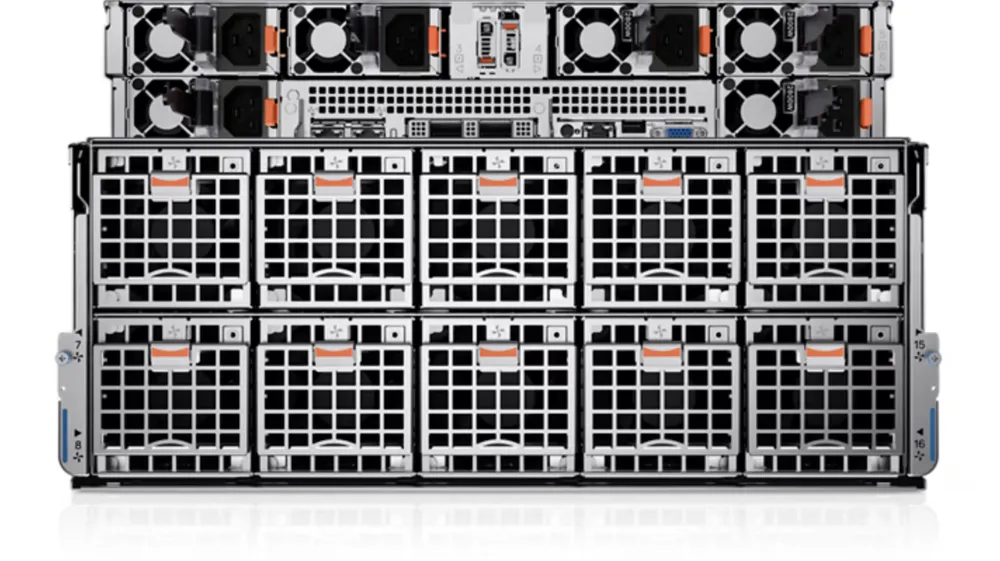
The PowerEdge servers are designed to deliver high-performance capabilities, with the R940 being a prime example. With its four sockets and support for up to 12 NMVe drives, the R940 provides scalable performance and can handle demanding workloads with ease. The server also features advanced cooling systems, including fans and heat sinks, to ensure optimal thermal performance and prevent overheating.
The R940 has been shown to perform ~18% better than the PowerEdge R930 with Broadwell-EX and ~45% better than Haswell-EX processors. In addition, the R940 supports up to 50% more NVMe drives than the R930, making it an ideal choice for applications that require high storage capacity and performance.
Market Positioning
The PowerEdge servers are positioned as high-performance, scalable, and reliable solutions for businesses of all sizes. With their advanced architecture and design, the PowerEdge servers are capable of handling a wide range of workloads, from virtualization and cloud computing to database management and analytics.
The PowerEdge R940, in particular, is positioned as a mission-critical server, designed to power the most demanding workloads and provide real-time decisions. With its advanced features, including automatic workload tuning and support for up to 6TB of memory, the R940 is an ideal choice for enterprises that require high-performance capabilities and scalability.
Verdict
In conclusion, the Dell PowerEdge servers are a comprehensive range of high-performance, scalable, and reliable solutions for businesses of all sizes. With their advanced architecture and design, the PowerEdge servers are capable of handling a wide range of workloads and providing real-time decisions. The PowerEdge R940, in particular, is a high-performance server designed for mission-critical applications and real-time decisions, making it an ideal choice for enterprises that require high-performance capabilities and scalability.
Overall, the PowerEdge servers offer a strong value proposition, with their advanced features, high-performance capabilities, and scalability making them an ideal choice for businesses that require reliable and efficient server solutions. Whether you are a small business or a large corporation, the PowerEdge servers are definitely worth considering for your server needs.
Specifications
| Server Type | Rack-mountable |
|---|---|
| Form Factor | 3U |
| Processors | Up to 4 Intel Xeon Scalable processors |
| Memory | Up to 6TB (24x 256GB or 12x 512GB) |
| Storage | Up to 12 NMVe drives |
| Networking | 2x 1GbE, 2x 10GbE, 2x 25GbE |
| Power Supply | Up to 2x 750W 80 PLUS Platinum |
| Operating System | Microsoft Windows Server, VMware ESXi, Linux |
Frequently Asked Questions
What is the PowerEdge R940 server designed for?
The PowerEdge R940 server is designed for mission-critical applications and real-time decisions, providing scalable performance and high storage capacity.
How many NMVe drives can the PowerEdge R940 support?
The PowerEdge R940 can support up to 12 NMVe drives.
What is the maximum amount of memory that the PowerEdge R940 can support?
The PowerEdge R940 can support up to 6TB of memory.
What operating systems are supported by the PowerEdge R940?
The PowerEdge R940 supports Microsoft Windows Server, VMware ESXi, and Linux.