Xanadu photonic quantum hardware
Xanadu Photonic Quantum Hardware: A Technical Deep-Dive
Executive Summary
Xanadu, a Canadian quantum computing company, has been making significant strides in the development of photonic quantum hardware. With the announcement of Aurora, a universal photonic quantum computer, Xanadu has demonstrated its commitment to scalable and fault-tolerant quantum computing. This article provides an exhaustive technical deep-dive into Xanadu's photonic quantum hardware, exploring its architecture, design, performance, and market positioning.
Xanadu's photonic quantum hardware is based on the principles of photonics, which uses light to perform quantum computations. This approach has several advantages over traditional quantum computing methods, including scalability, flexibility, and reduced noise. With the development of Aurora, Xanadu has taken a significant step towards realizing the potential of photonic quantum computing.
Architecture & Design
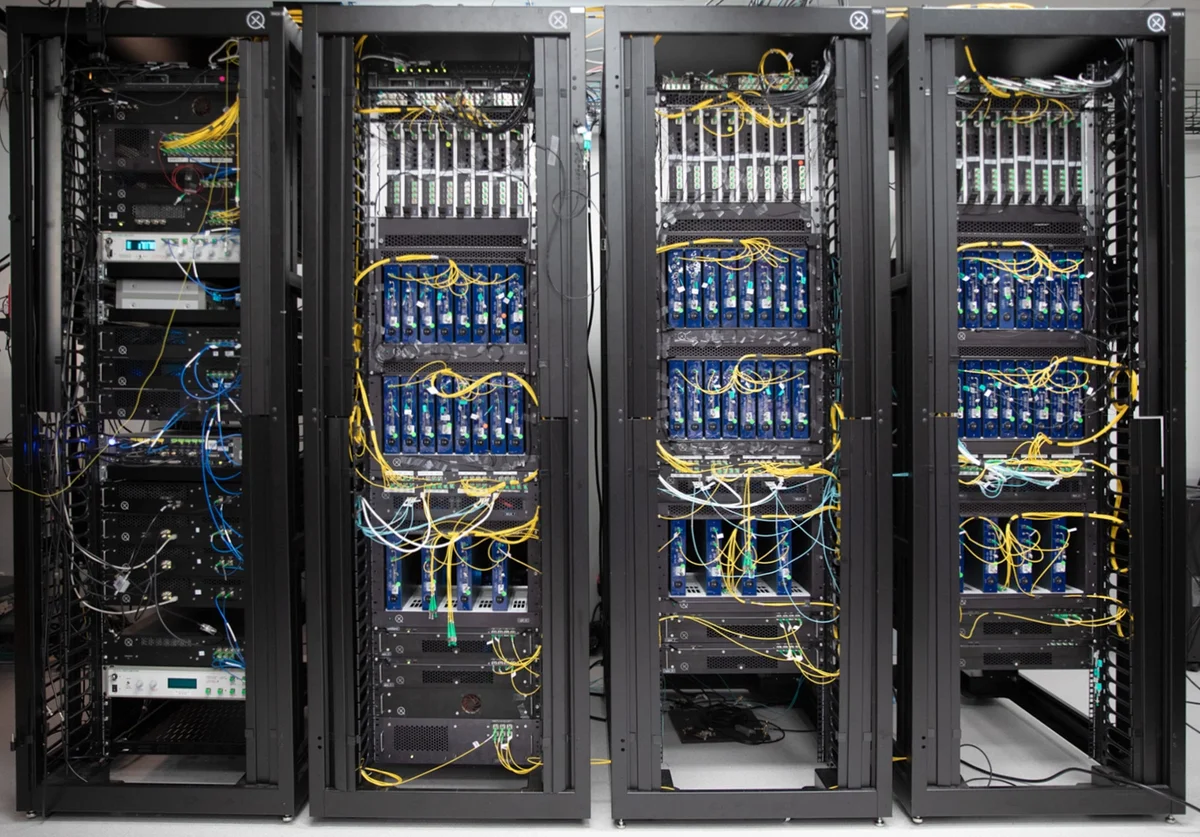
Aurora, Xanadu's universal photonic quantum computer, features a modular architecture consisting of four independent server racks interconnected using photonic technology. This design enables scalability to thousands of server racks and millions of qubits, making it an attractive solution for large-scale quantum computing applications. The system operates at room temperature, eliminating the need for complex cooling systems, and consists of 12 qubits, 35 photonic chips, and 13 kilometers of fiber optics.
The modular design of Aurora allows for easy integration of new components and upgrades, reducing the complexity and cost associated with traditional quantum computing systems. The use of commercially available photonic chips manufactured using established fabrication techniques also simplifies the production process and reduces the risk of errors.
Xanadu's photonic quantum hardware is designed to support a wide range of quantum computational processes, including gate operations, real-time error correction, and decoding. The system's reliance on photonics enables fast and efficient processing of quantum information, making it suitable for applications such as quantum simulation, machine learning, and cryptography.
Performance & Thermal
Xanadu's photonic quantum hardware has demonstrated impressive performance capabilities, with the ability to complete complex quantum computations in a matter of microseconds. The system's operating temperature, which is at room temperature, eliminates the need for complex cooling systems, reducing the overall power consumption and increasing the system's reliability.
The use of photonics in Xanadu's quantum hardware also reduces the noise and error rates associated with traditional quantum computing methods. This enables the system to maintain a high level of accuracy and precision, even when performing complex quantum computations. The reduced noise and error rates also simplify the process of error correction, making it easier to maintain the integrity of the quantum information being processed.
Xanadu's photonic quantum hardware has been designed to support a wide range of applications, from quantum simulation and machine learning to cryptography and optimization. The system's performance capabilities, combined with its scalability and flexibility, make it an attractive solution for a variety of industries, including finance, healthcare, and materials science.
Market Positioning
Xanadu's photonic quantum hardware is well-positioned in the market, with a unique combination of scalability, flexibility, and performance. The company's focus on photonics has enabled it to develop a system that is both powerful and practical, making it an attractive solution for a wide range of applications.
Xanadu's partnership with Tower Semiconductor, a leading foundry of high-value analog semiconductor solutions, has also enabled the company to develop advanced silicon photonics for fault-tolerant quantum computers. This partnership has provided Xanadu with access to high-volume silicon photonics platforms, enabling the company to scale its production and reduce costs.
Xanadu's photonic quantum hardware is also cloud-accessible, allowing users to access the system remotely and perform quantum computations on-demand. This cloud-based approach simplifies the process of using quantum computing, making it more accessible to a wider range of users and applications.
Verdict
Xanadu's photonic quantum hardware is a significant step forward in the development of scalable and fault-tolerant quantum computing. The company's focus on photonics has enabled it to develop a system that is both powerful and practical, making it an attractive solution for a wide range of applications.
With the announcement of Aurora, Xanadu has demonstrated its commitment to realizing the potential of photonic quantum computing. The company's partnership with Tower Semiconductor and its cloud-based approach to quantum computing have also positioned it for success in the market, enabling it to scale its production and reduce costs.
As the field of quantum computing continues to evolve, Xanadu's photonic quantum hardware is likely to play a significant role in shaping the future of the industry. With its unique combination of scalability, flexibility, and performance, Xanadu's system is well-positioned to support a wide range of applications, from quantum simulation and machine learning to cryptography and optimization.
Specifications
| Modular Architecture | 4 independent server racks |
|---|---|
| Scalability | Thousands of server racks and millions of qubits |
| Operating Temperature | Room temperature |
| Qubits | 12 |
| Photonic Chips | 35 |
| Fiber Optics | 13 kilometers |
| Error Correction | Real-time error correction and decoding |
| Cloud Accessibility | Cloud-accessible |
| Programming Language | Python |
Frequently Asked Questions
What is Xanadu's photonic quantum hardware?
Xanadu's photonic quantum hardware is a type of quantum computer that uses photonics to perform quantum computations.
What is the advantage of using photonics in quantum computing?
The use of photonics in quantum computing enables fast and efficient processing of quantum information, reduces noise and error rates, and simplifies the process of error correction.
What is Aurora, and what are its key features?
Aurora is Xanadu's universal photonic quantum computer, featuring a modular architecture, scalability to thousands of server racks and millions of qubits, and operating at room temperature.
How does Xanadu's photonic quantum hardware support a wide range of applications?
Xanadu's photonic quantum hardware supports a wide range of applications, including quantum simulation, machine learning, cryptography, and optimization, due to its scalability, flexibility, and performance capabilities.
What is the significance of Xanadu's partnership with Tower Semiconductor?
Xanadu's partnership with Tower Semiconductor enables the company to develop advanced silicon photonics for fault-tolerant quantum computers, providing access to high-volume silicon photonics platforms and simplifying the process of scaling production and reducing costs.