Xbox Series X
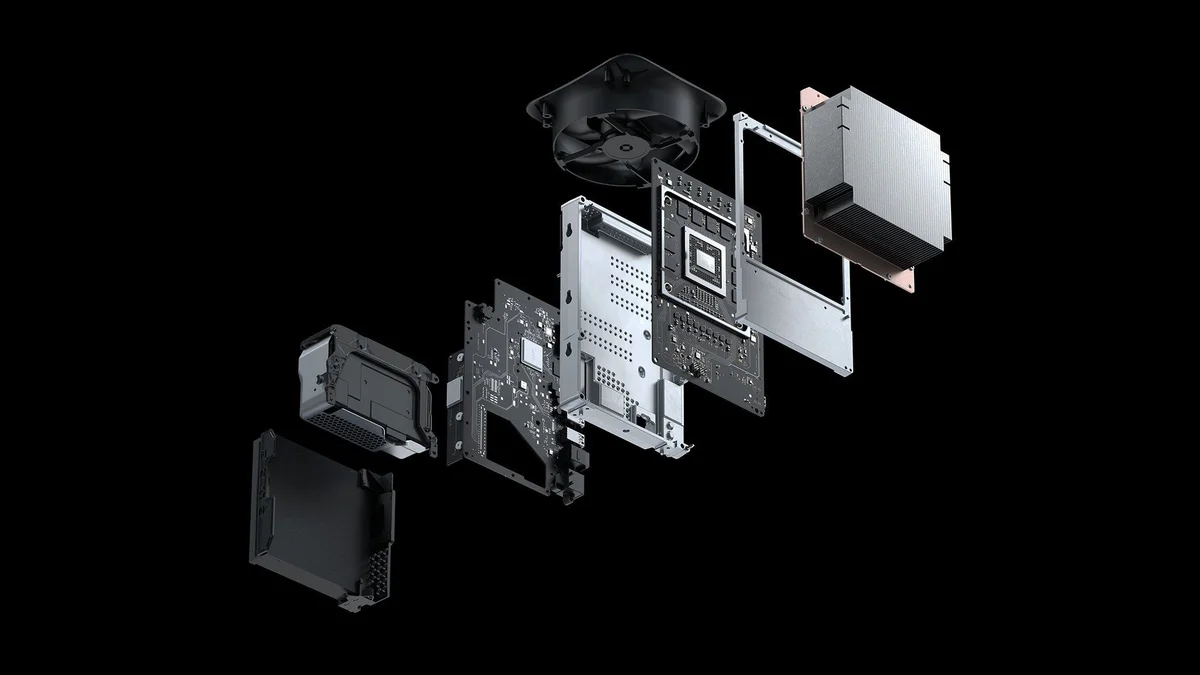
Executive Summary
The Xbox Series X is the latest gaming console from Microsoft, representing a significant leap forward in terms of performance, features, and design. With its custom AMD Zen 2 CPU, 12 TFLOP RDNA 2 GPU, and 16 GB of GDDR6 RAM, the Xbox Series X is poised to deliver unparalleled gaming experiences. This article provides an in-depth look at the console's architecture, design, performance, thermal management, and market positioning, as well as a verdict on its overall value proposition.
Architecture & Design
The Xbox Series X features a custom-designed CPU based on AMD's Zen 2 architecture, with 8 cores running at 3.8 GHz. The GPU is a custom AMD Radeon RDNA 2 unit with 40 CUs at 1.825 GHz, delivering 12 TFLOPS of performance. The console also includes 16 GB of GDDR6 RAM, with a 320mb bus and 10 GB @ 560 GB/s and 6 GB @ 336 GB/s memory bandwidth. The Xbox Series X uses a 1 TB custom NVME SSD for internal storage, with 2.4 GB/s raw and 4.8 GB/s compressed I/O throughput.
The console's design is sleek and modern, with a matte black finish and a compact size of 301mm x 151mm x 151mm. The Xbox Series X also features a 4K UHD Blu-ray drive, as well as support for external storage via USB 3.2 and an expansion card slot. The console's I/O capabilities include 2x HDMI ports, 2x USB-C ports, an Ethernet port, and an optical out port.
Performance & Thermal
The Xbox Series X is designed to deliver exceptional performance, with a target frame rate of 60 FPS at 4K resolution and up to 120 FPS at lower resolutions. The console's custom GPU and CPU are optimized for ray tracing, variable rate shading, and hardware-accelerated DirectX Raytracing. The Xbox Series X also features a quick resume function for multiple games simultaneously, thanks to its advanced processing power.
In terms of thermal management, the Xbox Series X uses a custom-designed cooling system to keep the console's components at a safe temperature. The console's 7nm process and RDNA 2 architecture also contribute to its power efficiency, with a power consumption of around 25 watts less than the previous generation.
Market Positioning
The Xbox Series X is positioned as a premium gaming console, with a focus on delivering high-performance gaming experiences and advanced features. The console's price point is expected to be around $500, which is competitive with other next-generation consoles on the market. The Xbox Series X is also designed to be backwards compatible with previous generations of Xbox games, making it an attractive option for gamers with existing libraries.
Microsoft is also emphasizing the Xbox Series X's support for cloud gaming, with the ability to stream games from the console to other devices via the xCloud service. This feature is expected to be a major differentiator for the Xbox Series X, as it will allow gamers to play their favorite games on a variety of devices, including smartphones and tablets.
Verdict
The Xbox Series X is an impressive gaming console that delivers exceptional performance, features, and design. With its custom AMD Zen 2 CPU, 12 TFLOP RDNA 2 GPU, and 16 GB of GDDR6 RAM, the console is well-equipped to handle the demands of next-generation gaming. The Xbox Series X's support for ray tracing, variable rate shading, and hardware-accelerated DirectX Raytracing also make it an attractive option for gamers who want the best possible visual experience.
While the console's price point may be a barrier for some gamers, the Xbox Series X's backwards compatibility, cloud gaming features, and premium design make it a compelling option for those who want a high-end gaming experience. Overall, the Xbox Series X is a significant leap forward for Microsoft's gaming division, and it is likely to be a major player in the next-generation console market.
Specifications
| Processor | 8x Cores @ 3.8 GHz (3.66 GHz w/ SMT) Custom Zen 2 CPU |
|---|---|
| Graphics | 12.155 TFLOPS, 52 CUs @ 1.825 GHz Custom RDNA 2 GPU |
| Die Size | 360.45 mm2 |
| Process | 7nm Enhanced |
| Memory | 16 GB GDDR6 w/ 320mb bus |
| Memory Bandwidth | 10 GB @ 560 GB/s, 6GB @ 336 GB/s |
| Internal Storage | 1 TB Custom NVME SSD |
| I/O Throughput | 2.4 GB/s (Raw), 4.8 GB/s (Compressed, with custom hardware decompression block) |
| Expandable Storage | 1 TB Expansion Card (matches internal storage exactly) |
| External Storage | USB 3.2 External HDD Support |
| Optical Drive | 4K UHD Blu-Ray Drive |
| Performance Target | 4K @ 60 FPS, up to 4K @ 120 FPS, 8K @ 60 FPS |
| Color | Matte Black |
| Size | 301mm x 151mm x 151mm |
| Release Date | Holiday 2020 |
Frequently Asked Questions
What is the processor used in the Xbox Series X?
The Xbox Series X uses a custom AMD Zen 2 CPU with 8 cores running at 3.8 GHz.
What is the graphics processing unit (GPU) used in the Xbox Series X?
The Xbox Series X uses a custom AMD Radeon RDNA 2 GPU with 40 CUs at 1.825 GHz, delivering 12 TFLOPS of performance.
How much memory does the Xbox Series X have?
The Xbox Series X has 16 GB of GDDR6 RAM, with a 320mb bus and 10 GB @ 560 GB/s and 6 GB @ 336 GB/s memory bandwidth.
What type of storage does the Xbox Series X use?
The Xbox Series X uses a 1 TB custom NVME SSD for internal storage, with 2.4 GB/s raw and 4.8 GB/s compressed I/O throughput.
Is the Xbox Series X backwards compatible with previous generations of Xbox games?
Yes, the Xbox Series X is designed to be backwards compatible with previous generations of Xbox games, including original Xbox games.