Xeon
Xeon: The Evolution of Enterprise-Class Processors
The Xeon brand has been a stalwart in the world of enterprise-class processors for over two decades, with a legacy that spans from the early days of IA-32 to the current x86-64 architecture. Introduced in 1998, Xeon processors were designed to cater to the needs of non-consumer workstations, servers, and embedded markets. In this article, we will delve into the evolution of Xeon processors, exploring their architecture, performance, market positioning, and the impact they have had on the industry.
The Xeon brand has undergone significant changes over the years, with the introduction of new features, architectures, and product lines. One of the earliest notable changes was the addition of the Xeon moniker to the end of the name of their corresponding desktop processor. However, all models since 2001 have used the name Xeon on its own. The Xeon CPUs generally have more cache and cores than their desktop counterparts in addition to multiprocessing capabilities.
One of the most significant advancements in Xeon processors was the introduction of the Xeon Scalable brand in 2017. This brand was designed for high-performance servers and offered a range of processors with dual socket to 8 socket support. Within the Xeon Scalable brand, there exists a hierarchy of Xeon Bronze, Silver, Gold, and Platinum. The Xeon Scalable brand has been instrumental in providing the necessary performance and scalability for modern data centers.
However, in April 2024, Intel announced that the Xeon Scalable brand would be retired, beginning with the 6th generation Xeon processors codenamed Sierra Forest and Granite Rapids. The new branding convention will focus on processor generation numbers, with the # being the generation of the processor. For example, the Xeon 6 6700E line is an all E-core based (Sierra Forest) line of processors.
The Xeon 6 processor family is split into two product lines: the E series and P series. The E series is all E-core designs, while the P series is all P-core designs. The Xeon 6 processors with E-cores are built to tackle the most challenging network and edge workloads. With up to 144 Efficient-cores (E-cores) per socket, these processors provide unprecedented design density, performance per watt, and integrated accelerators to boost critical tasks.
The Xeon 6 processor family introduces a robust computing platform that excels at both performance and efficiency. From powering compute-intensive workloads to enabling scalable cloud-native microservices, the processor family provides versatility for diverse operational requirements. The integrated accelerators provide targeted enhancements for network and security workloads, amplifying overall efficiency and productivity.
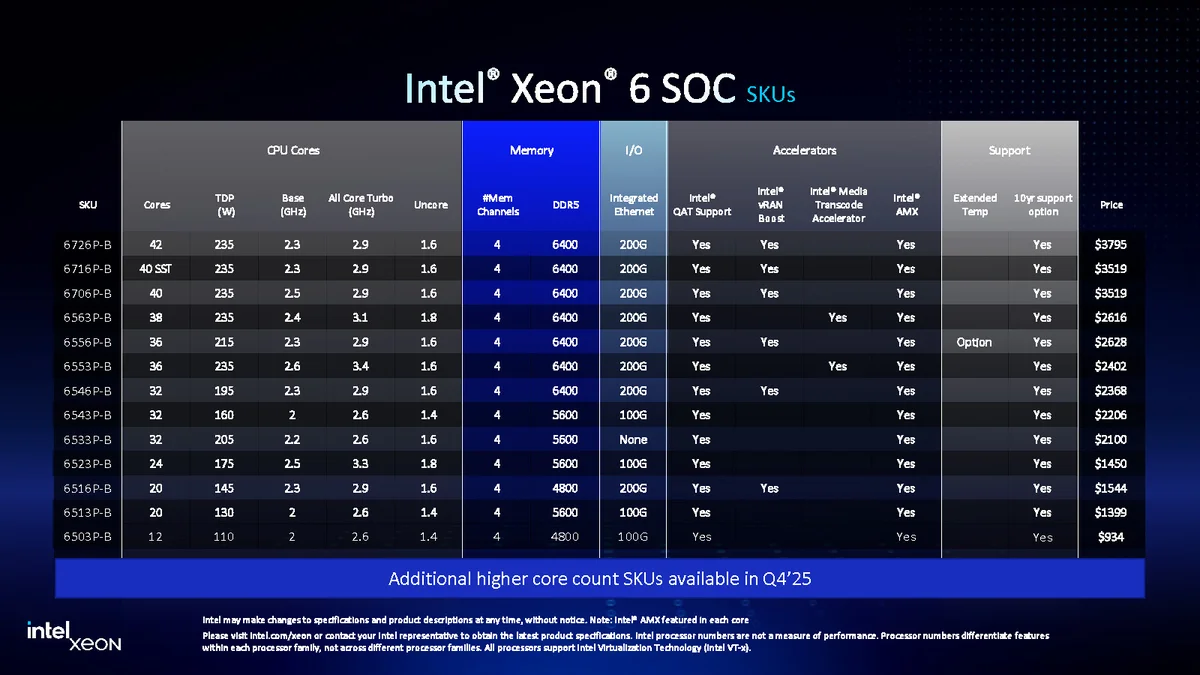
The Xeon 6 SoC marks a major step forward in AI-enabled computing for networking, media, and security applications. With high-performance cores, built-in acceleration, and advanced networking capabilities, this processor delivers superior performance, reduced operational costs, and a scalable foundation for AI-driven workloads.
The Xeon 6 processors with P-cores and E-cores are highlighted by their ability to provide scalable performance per watt as server utilization increases. Delivering nearly linear power-performance consumption across the load line, these processors are designed to meet the evolving demands of modern data centers.
The Xeon 6 processor family delivers new degrees of performance and scalability to address a wide variety of deployments across data center, enterprise, networking, and edge. The diversity of workloads, power, performance, and form factor requirements led to Intel's most advanced modular system on chip (SoC) processor architecture. This modular construction allows the flexibility to meet the needs of a wide range of applications.
In conclusion, the Xeon brand has come a long way since its introduction in 1998. From the early days of IA-32 to the current x86-64 architecture, Xeon processors have evolved to meet the needs of the enterprise market. With the introduction of the Xeon Scalable brand and the Xeon 6 processor family, Intel has provided the necessary performance and scalability for modern data centers. As the industry continues to evolve, it will be interesting to see how Xeon processors adapt to meet the changing demands of the market.
As we look to the future, it is clear that Xeon processors will continue to play a significant role in the world of enterprise-class computing. With their focus on performance, scalability, and efficiency, Xeon processors are well-positioned to meet the needs of modern data centers. Whether it's powering compute-intensive workloads or enabling scalable cloud-native microservices, Xeon processors will continue to be a stalwart in the industry.
As we conclude this article, it is clear that Xeon processors have come a long way since their introduction in 1998. From the early days of IA-32 to the current x86-64 architecture, Xeon processors have evolved to meet the needs of the enterprise market. With the introduction of the Xeon Scalable brand and the Xeon 6 processor family, Intel has provided the necessary performance and scalability for modern data centers. As the industry continues to evolve, it will be interesting to see how Xeon processors adapt to meet the changing demands of the market.
As we look to the future, it is clear that Xeon processors will continue to play a significant role in the world of enterprise-class computing. With their focus on performance, scalability, and efficiency, Xeon processors are well-positioned to meet the needs of modern data centers. Whether it's powering compute-intensive workloads or enabling scalable cloud-native microservices, Xeon processors will continue to be a stalwart in the industry.
Specifications
| Socket Support | Dual socket to 8 socket |
|---|---|
| Cache Memory | Larger cache memory |
| Core Count | Higher core counts |
| PCIe Lanes | More PCI Express (PCIe) lanes |
| RAM Support | Support for larger amounts of RAM |
| ECC Memory | Support for error correction code (ECC) memory |
| RAS Features | Extra provision for enterprise-grade reliability, availability and serviceability (RAS) features |
| Machine Check Architecture | Support for Machine Check Architecture (MCA) |
| Ultra Path Interconnect | Support for Ultra Path Interconnect (UPI) bus |
| QuickPath Interconnect | Support for QuickPath Interconnect (QPI) bus |
| Xeon Scalable Brand | Retired in April 2024 |
| Xeon 6 Processor Family | Introduced in April 2024 |
| E Series | All E-core designs |
| P Series | All P-core designs |
| Integrated Accelerators | Targeted enhancements for network and security workloads |
| AI-Enabled Computing | Support for AI-enabled computing for networking, media, and security applications |
| High-Performance Cores | Built-in acceleration and advanced networking capabilities |
Frequently Asked Questions
What is the Xeon brand?
The Xeon brand is a line of x86 microprocessors designed, manufactured, and marketed by Intel for non-consumer workstation, server, and embedded markets.
What is the Xeon Scalable brand?
The Xeon Scalable brand is a line of high-performance server processors introduced in 2017, offering dual socket to 8 socket support.
What is the Xeon 6 processor family?
The Xeon 6 processor family is a line of processors introduced in April 2024, offering a robust computing platform that excels at both performance and efficiency.