Zen 6
Executive Summary
AMD's upcoming Zen 6 microarchitecture is a significant departure from its predecessors, marking a deliberate shift towards a wide, throughput-oriented design. This new approach is expected to bring substantial improvements in performance, efficiency, and AI capabilities. With the introduction of Zen 6, AMD aims to solidify its position in the CPU market, offering a competitive alternative to Intel's offerings.
The Zen 6 microarchitecture is designed to utilize TSMC's 3 nm and 2 nm processes, enabling the creation of high-performance CPUs with increased core counts and improved power efficiency. The architecture is expected to introduce new instruction extensions, including AVX512_BMM, AVX_NE_CONVERT, AVX_IFMA, AVX_VNNI_INT8, and AVX512_FP16, as well as FRED. These additions will enhance the CPU's capabilities in various workloads, particularly in AI and machine learning applications.
Architecture & Design
The Zen 6 microarchitecture features a brand-new 8-wide CPU core with strong vector capabilities. This design is a significant departure from the previous Zen 5 architecture, which was more focused on incremental improvements. The new core has an eight-slot dispatch engine and simultaneous multi-threading (SMT), allowing two hardware threads to dynamically contend for a shared pool of dispatch slots. This approach enables high performance in certain workloads, although it may not always result in the highest single-thread performance.
The Zen 6 core also includes dedicated counters for unused dispatch slots, backend stalls, and thread-selection losses. These counters provide valuable insights into the core's performance and help developers optimize their applications for the new architecture. Furthermore, the core supports full-width AVX-512 execution with FP64, FP32, FP16, and BF16 data formats, including FMA/MAC operations and mixed FP-INT vector execution.
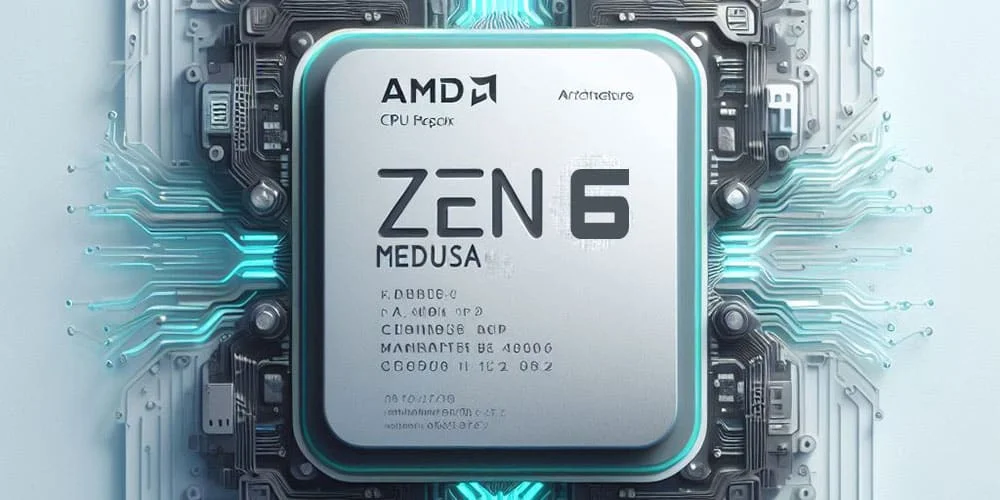
The Zen 6 microarchitecture is expected to be used in a variety of applications, including desktop processors, server processors, and mobile platforms. The desktop processors will be codenamed "Medusa" and will be released under the Ryzen 10000 name. The server processors will be codenamed "Venice" and will be part of the EPYC lineup. The mobile platforms will utilize the Zen 6c variant, which is optimized for high-core-density and power efficiency.
Performance & Thermal
The Zen 6 microarchitecture is designed to deliver high performance and efficiency. The new core design and instruction extensions enable the CPU to handle demanding workloads with ease, making it an attractive option for applications that require high levels of processing power. The CPU's ability to support full-width AVX-512 execution and mixed FP-INT vector execution also makes it well-suited for tasks that involve complex mathematical calculations.
In terms of thermal performance, the Zen 6 microarchitecture is expected to offer improved power efficiency compared to its predecessors. The use of TSMC's 3 nm and 2 nm processes enables the creation of CPUs with lower power consumption and heat generation. This makes the Zen 6 microarchitecture an attractive option for applications where power efficiency is a key consideration, such as in mobile devices and data centers.
Market Positioning
The Zen 6 microarchitecture is expected to be a significant player in the CPU market, offering a competitive alternative to Intel's offerings. The new architecture's focus on throughput and vector capabilities makes it an attractive option for applications that require high levels of processing power, such as AI and machine learning workloads. The CPU's improved power efficiency and thermal performance also make it well-suited for use in mobile devices and data centers.
The Zen 6 microarchitecture is expected to be released in late 2026 to early 2027, with the desktop processors being released under the Ryzen 10000 name. The server processors will be part of the EPYC lineup and will be codenamed "Venice". The mobile platforms will utilize the Zen 6c variant, which is optimized for high-core-density and power efficiency.
Verdict
In conclusion, the Zen 6 microarchitecture is a significant departure from AMD's previous architectures, marking a deliberate shift towards a wide, throughput-oriented design. The new core design and instruction extensions enable the CPU to handle demanding workloads with ease, making it an attractive option for applications that require high levels of processing power. The CPU's improved power efficiency and thermal performance also make it well-suited for use in mobile devices and data centers.
The Zen 6 microarchitecture is expected to be a significant player in the CPU market, offering a competitive alternative to Intel's offerings. With its focus on throughput and vector capabilities, the Zen 6 microarchitecture is well-positioned to handle the demands of emerging workloads, such as AI and machine learning. As the CPU market continues to evolve, the Zen 6 microarchitecture is likely to play a key role in shaping the future of computing.
Specifications
| Microarchitecture | Zen 6 |
|---|---|
| Process Node | 3 nm and 2 nm |
| Core Count | Up to 24 cores |
| Thread Count | Up to 48 threads |
| Instruction Extensions | AVX512_BMM, AVX_NE_CONVERT, AVX_IFMA, AVX_VNNI_INT8, AVX512_FP16, FRED |
| Dispatch Engine | 8-wide |
| Simultaneous Multi-Threading (SMT) | Yes |
| AVX-512 Execution | Full-width |
| Data Formats | FP64, FP32, FP16, BF16 |
| Release Date | Late 2026 to Early 2027 |
Frequently Asked Questions
What is the Zen 6 microarchitecture?
The Zen 6 microarchitecture is a new CPU design from AMD, featuring a wide, throughput-oriented core with strong vector capabilities.
What are the key features of the Zen 6 microarchitecture?
The Zen 6 microarchitecture features a brand-new 8-wide CPU core, simultaneous multi-threading, and support for full-width AVX-512 execution with various data formats.
What are the expected applications of the Zen 6 microarchitecture?
The Zen 6 microarchitecture is expected to be used in a variety of applications, including desktop processors, server processors, and mobile platforms.
When is the Zen 6 microarchitecture expected to be released?
The Zen 6 microarchitecture is expected to be released in late 2026 to early 2027.