Cray T3D
Executive Summary
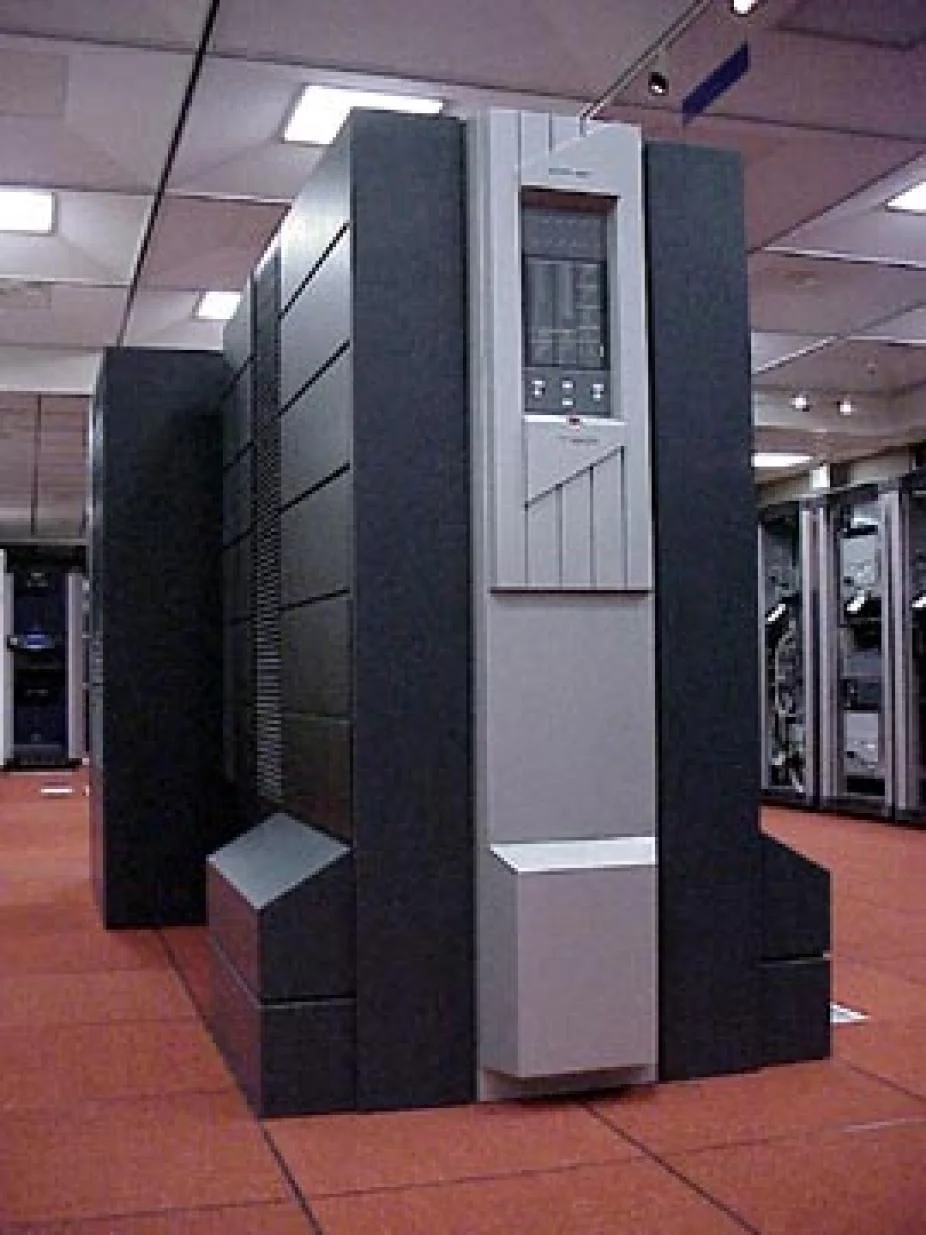
The Cray T3D, launched in 1993, was Cray Research's first attempt at a massively parallel supercomputer architecture. It marked a significant milestone as Cray's first use of another company's microprocessor. The T3D was designed to be hosted by a Cray Y-MP Model E, M90, or C90-series front-end system, relying on it and its UNICOS operating system for all I/O and most system services. This supercomputer was a pioneering effort in the field of high-performance computing, showcasing Cray's commitment to innovation and advancement in the industry. The T3D's introduction was a notable event, with the first prototype delivered to the Pittsburgh Supercomputing Center in early September 1993. The supercomputer was formally introduced on September 27, 1993, marking the beginning of a new era in massively parallel computing. The T3D was eventually superseded by the faster and more sophisticated Cray T3E in 1995.Architecture & Design
The Cray T3D consisted of between 32 and 2048 Processing Elements (PEs), each comprising a 150 MHz DEC Alpha 21064 (EV4) microprocessor and either 16 or 64 MB of DRAM. The PEs were grouped in pairs, or nodes, which incorporated a 6-way processor interconnect switch. These switches had a peak bandwidth of 300 MB/second in each direction and were connected to form a three-dimensional torus network topology. The T3D was designed to be highly scalable, with several different configurations available. The SC (Single Cabinet) models shared a cabinet with a host Y-MP system and were available with either 128 or 256 PEs. The MC (Multi-Cabinet) models were housed in one or more liquid-cooled cabinets separately from the host, while the MCA models were smaller (32 to 128 PEs) air-cooled multi-cabinet configurations. There was also a liquid-cooled MCN model, which had an alternative interconnect wire mat allowing non-power-of-2 numbers of PEs. One of the unique features of the Cray T3D MC cabinet was the inclusion of an Apple Macintosh PowerBook laptop built into its front. The laptop's sole purpose was to display animated Cray Research and T3D logos on its color LCD screen. This feature, although not directly related to the computational capabilities of the T3D, showcased the attention to detail and innovative spirit of Cray Research. The T3D PEs ran a simple microkernel called UNICOS MAX, which was designed to provide a lightweight and efficient operating system for the massively parallel architecture. The use of a microkernel allowed for a high degree of customization and flexibility, enabling the T3D to be tailored to specific applications and workloads.Performance & Thermal
The performance of the Cray T3D was notable for its time, with the ability to scale up to 2048 Processing Elements. However, specific benchmark scores and thermal design power (TDP) are not publicly disclosed in the provided research material. The peak bandwidth of the 6-way processor interconnect switch was 300 MB/second in each direction, which was a significant achievement in terms of interconnect technology at the time. The cooling systems used in the T3D were also noteworthy, with liquid-cooled cabinets available for the MC and MCN models. The use of liquid cooling allowed for more efficient heat dissipation, enabling the T3D to operate at higher densities and performance levels. However, detailed specifications of the cooling systems, such as the coolant used and the heat transfer mechanisms, are not provided in the research material.Market Positioning
The Cray T3D was positioned as a high-end supercomputer, targeting applications that required massive parallel processing capabilities. The pricing of the T3D is not publicly disclosed in the provided research material. However, it is known that the T3D was used in various high-performance computing applications, including climate modeling and scientific simulations. The T3D was part of a broader ecosystem of Cray Research products, including the Y-MP Model E, M90, and C90-series front-end systems. The use of these front-end systems provided a comprehensive solution for high-performance computing, with the T3D serving as the massively parallel processing component.Verdict
The Cray T3D was a groundbreaking supercomputer that marked a significant milestone in the development of massively parallel computing architectures. Although it has been superseded by more modern systems, the T3D remains an important part of the history of high-performance computing. Its innovative design, scalable architecture, and high-performance capabilities made it an attractive solution for applications that required massive parallel processing. The legacy of the T3D can be seen in the subsequent generations of Cray Research products, including the T3E and other high-performance computing systems. The T3D's impact on the industry was significant, demonstrating the potential of massively parallel computing and paving the way for future innovations in the field. In conclusion, the Cray T3D was a pioneering effort in the development of high-performance computing systems. Its unique architecture, scalable design, and high-performance capabilities made it an important part of the history of computing. Although specific details about its performance and thermal design are not publicly disclosed, the T3D remains a notable achievement in the field of massively parallel computing.Specifications
| Microprocessor | DEC Alpha 21064 (EV4) |
|---|---|
| Clock Speed | 150 MHz |
| DRAM | 16 or 64 MB |
| Peak Bandwidth | 300 MB/second |
| Number of Processing Elements (PEs) | 32 to 2048 |
| Interconnect Topology | Three-dimensional torus network |
| Operating System | UNICOS MAX microkernel |
Frequently Asked Questions
What was the first Cray T3D prototype delivered to?
The Pittsburgh Supercomputing Center in early September 1993
What was the formal introduction date of the Cray T3D?
September 27, 1993
What was the Cray T3D superseded by?
The Cray T3E in 1995
What was the purpose of the Apple Macintosh PowerBook laptop in the Cray T3D MC cabinet?
To display animated Cray Research and T3D logos on its color LCD screen
What was the operating system used by the T3D PEs?
UNICOS MAX microkernel